
You are standing in your driveway holding two quotes for a new air conditioner. One lists a SEER2 rating of 14.3. The other lists 16. The salesperson on the phone said "higher is always better," but nobody explained what the number actually measures or whether it matters at 6,035 feet. That confusion is exactly where honest answers should start.
Key Takeaways
- SEER2 replaced SEER in 2023: The federal testing method changed to reflect real-world ductwork resistance, so SEER2 numbers are not directly comparable to old SEER numbers.
- Altitude changes how efficiency plays out: Thinner air at Colorado Springs elevation affects airflow and combustion, which means proper sizing matters as much as the rating on the label.
- SEER2 and R-454B arrived together: The efficiency standard update and the refrigerant transition both reshaped equipment lineups, and understanding one helps you understand the other.
- Xcel Energy rebates reward higher efficiency: Qualifying heat pumps can unlock rebates up to $2,250, making the SEER2 number a financial detail, not just a technical one.
- A higher number is not automatically the right choice: The best system is the one sized and installed correctly for your specific home, not the one with the biggest rating on the brochure.
1. What SEER2 Is and How It Differs From Old SEER Testing
SEER2 stands for Seasonal Energy Efficiency Ratio 2, and it measures how much cooling an air conditioner or heat pump produces per unit of electricity consumed over a typical season. The higher the number, the more cooling you get for the electricity you pay for. That part is not new. What changed is how the number gets calculated, and that difference matters more than most homeowners realize when they are comparing quotes side by side.
The old SEER test measured equipment performance using external static pressure conditions that did not reflect how most systems actually operate once installed in a real duct system. SEER2 testing uses higher, more realistic external static pressure, which better represents the resistance air encounters moving through actual ductwork, filters, and coils. The result is a rating that more honestly reflects what a homeowner will experience, but it also means a system rated 14 SEER under the old method is not equivalent to a system rated 14 under SEER2.
Why the Numbers Look Different on Paper
A unit that used to carry a SEER rating of 16 might now carry a SEER2 rating closer to 15.2, even though nothing about the physical equipment changed. This is a testing methodology shift, not a performance downgrade. If you are cross-shopping a quote that references an older SEER number against a newer SEER2 number, you are not comparing apples to apples, and that is a common source of homeowner confusion when getting multiple bids.
The Federal Minimum Baseline
The Department of Energy sets minimum efficiency standards that manufacturers must meet, and those minimums are expressed in SEER2 terms as of the 2023 update. You can review the current regional minimum standards directly through ENERGY STAR's central air conditioner guidance, which breaks down the baseline requirements by climate region. Colorado Springs falls under the general national standard rather than the stricter southern climate zone rules.
What This Means for Comparing Quotes
When a comfort advisor hands you a quote, ask specifically whether the SEER2 number reflects the same testing standard as any other quote you are holding. If one contractor is quoting an older piece of equipment still in inventory and another is quoting current-production equipment, the ratings may not line up cleanly even if both numbers sound similar on the surface.
2. Why the Federal Efficiency Standard Changed in 2023
The efficiency standard update did not happen in isolation. It was part of a broader Department of Energy effort to make efficiency labels reflect real installed performance rather than laboratory conditions that rarely matched what happened in an actual attic, crawlspace, or basement duct run. Contractors and manufacturers had raised this concern for years, since older testing allowed equipment to post impressive numbers under conditions few homes actually replicated.
For homeowners, the practical effect is that the rating on your new system's label should track more closely with what you actually experience in energy bills and comfort. That is a genuine improvement, but it also means homeowners comparing a system installed before 2023 against a new replacement need to understand that a straight number comparison will slightly understate how efficient the new equipment really is relative to the old testing method.
How the Transition Affected Equipment Availability
Manufacturers spent time before and after the changeover updating product lines, testing documentation, and certification paperwork. During that transition window, some contractors carried mixed inventory of equipment tested under both standards. If you got a quote in the past couple of years and are now shopping again, it is worth asking whether the number you were quoted reflects current SEER2 testing or carries over from older documentation.
What Stayed the Same
The underlying engineering goal did not change. A well-built condenser, a properly matched evaporator coil, and a correctly sized system still deliver comfort and efficiency regardless of which testing standard produced the label. SEER2 is a more honest yardstick, not a different product category.
3. How SEER2 Numbers Affect Your Next AC Installation Choice
When you are staring at a stack of quotes, the SEER2 number is one data point among several that determine whether a system will actually perform well in your home. A higher-rated unit paired with undersized ductwork, a leaky duct system, or an oversized condenser can underperform a lower-rated unit that was installed correctly and matched precisely to your home's load. This is where honest diagnostics matter more than the sticker number.
Homeowners in older Colorado Springs neighborhoods, including parts of the Old North End and homes without modern ductwork, sometimes get quoted high-SEER2 equipment that cannot deliver its rated performance because the distribution system was never designed for it. A comfort advisor doing an honest job will talk about duct condition and airflow capacity alongside the equipment rating, not just the number on the box.
The table below shows how SEER2 ratings generally map to system tiers, which can help you frame conversations with contractors without needing to memorize technical specifications.
| System Tier | Typical SEER2 Range | What It Usually Means |
|---|---|---|
| Baseline / entry | 13.4 to 14.3 | Meets minimum federal standard, lower upfront cost |
| Mid-efficiency | 15 to 17 | Balance of upfront cost and long-term energy savings |
| High-efficiency | 18 and above | Higher upfront investment, often variable-speed compressors |
| Cold climate heat pump | Varies, often 15+ | Optimized for winter performance as well as cooling |
Reading this table, notice that the range itself does not tell you whether a system is right for your house. A mid-efficiency system installed with sealed, properly sized ductwork often outperforms a high-efficiency system fighting leaky ducts and airflow restrictions. The rating describes the equipment's potential, not a guarantee.
Matching the Rating to Your Actual Load Calculation
Every honest AC installation should start with a load calculation that accounts for your home's square footage, insulation, window exposure, and, in Colorado Springs, elevation. A system oversized for the load short-cycles, wastes energy, and struggles to dehumidify, regardless of its SEER2 rating. A correctly sized system, even at a moderate rating, tends to deliver more consistent comfort.
Questions Worth Asking Before You Sign
Ask whether the quote includes a Manual J load calculation, whether the ductwork was inspected as part of the estimate, and whether the SEER2 number quoted reflects the specific outdoor and indoor coil combination being installed, since mismatched components can quietly lower the effective rating.
4. What Higher SEER2 Ratings Mean for Energy Bills at Altitude
Colorado Springs sits at roughly 6,035 feet, and thinner air at that elevation genuinely changes how HVAC equipment performs. Air density drops as elevation increases, which affects combustion in gas furnaces and can influence how condensers and blowers move air through a system. This is a technical detail that many national HVAC guides simply do not address, because most manufacturers write their documentation for sea-level or near-sea-level installations.
For air conditioning specifically, the practical effect of altitude shows up less dramatically than it does for furnace combustion, but it still matters for equipment selection and airflow design. Correct static pressure calibration and proper refrigerant charge become more important at altitude, because a system that is slightly off on either front will underperform its rated SEER2 number more noticeably than the same mistake would cause at lower elevation.
Why Local Sizing Expertise Matters
A comfort advisor who understands Colorado Springs elevation will factor altitude into the load calculation and airflow setup rather than applying a generic sea-level formula. This is one of the reasons equipment sizing done by a locally experienced contractor tends to produce better real-world results than a rating chosen off a spec sheet alone. The Department of Energy's general guidance on central air conditioner efficiency is a useful baseline, but it does not account for elevation-specific adjustments, which is where local expertise fills the gap.
Translating SEER2 Into Actual Bill Savings
Because SEER2 measures seasonal performance, a higher-rated system generally uses less electricity to deliver the same cooling output over a full summer, assuming correct installation. Colorado Springs summers are shorter and milder than many parts of the country, so the payback period on jumping several SEER2 points higher should be discussed honestly rather than assumed. A comfort advisor should walk through your specific usage patterns rather than quoting a generic national savings percentage, since your actual bill impact depends on your home's insulation, your thermostat habits, and how many cooling hours your household typically runs.
5. How SEER2 Connects to the R-454B Refrigerant Transition
The SEER2 testing change did not happen in a vacuum. Around the same period, the HVAC industry began transitioning away from R-410A refrigerant toward lower global-warming-potential alternatives, most notably R-454B, under EPA phasedown rules. If you are shopping for a new AC system right now, you are shopping during a period when both the efficiency rating standard and the refrigerant used inside the equipment are shifting at the same time, and that overlap is part of why current quotes can look different from quotes you may have gotten a few years ago.
R-454B is mildly flammable, classified as an A2L refrigerant, which means manufacturers had to redesign components, update safety documentation, and retrain installers on handling procedures. The EPA's refrigerant transition guidance outlines the regulatory timeline and the reasoning behind the shift toward lower-impact refrigerants. For homeowners, the practical takeaway is that new equipment installed today is likely to use R-454B or another approved low-GWP refrigerant, and your comfort advisor should be certified to handle it correctly.
Why This Matters for Your Installation Quote
Because R-454B systems use different components and handling protocols than older R-410A systems, installation requires specific training. An installer who has not updated their certification for A2L refrigerants may not be equipped to service or install this newer equipment safely and correctly, which is worth confirming directly when you are comparing bids from different companies.
What Homeowners With Existing R-410A Systems Should Know
If your current system uses R-410A, it will continue to function, and parts and service will remain available for a transition period. You do not need to replace a working system solely because of the refrigerant change. The refrigerant transition becomes relevant when you are already shopping for a new system, at which point understanding what refrigerant your new equipment uses is a reasonable question to ask alongside the SEER2 rating.
6. Xcel Energy Rebates Tied to Efficiency Ratings
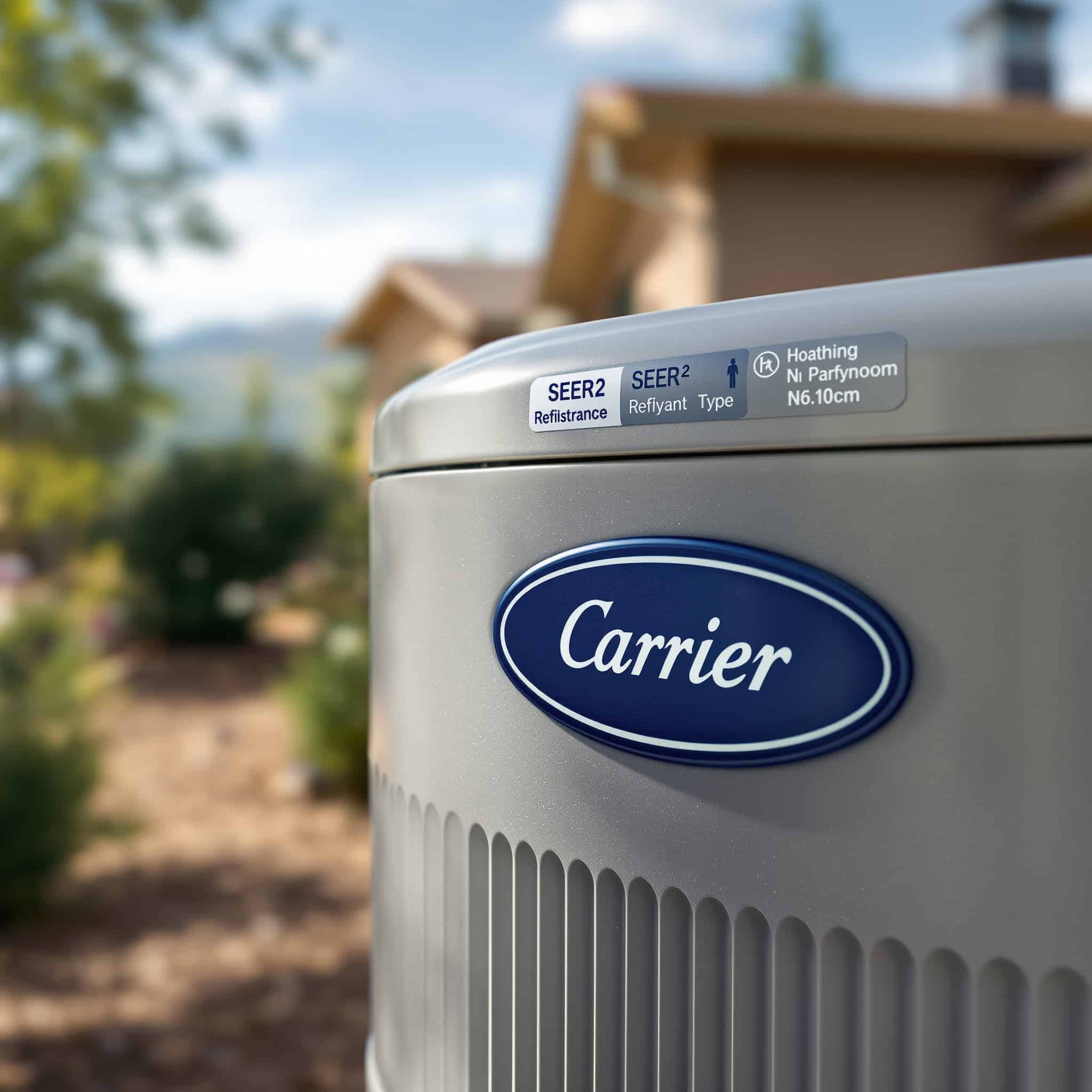
Efficiency ratings are not just a technical spec, they are also a financial lever, because utility rebate programs are structured around minimum SEER2 and HSPF2 thresholds. Xcel Energy offers rebates for qualifying high-efficiency heat pumps, with amounts reaching up to $2,250 for systems that meet program requirements. This is a real, verifiable utility program benefit, separate from any pricing A & Z Mechanical quotes for installation labor or equipment.
Rebate programs change their qualifying thresholds periodically as efficiency standards evolve, so a system that qualified for a rebate tier last year may not automatically qualify under updated program rules, and a system that did not qualify previously might newly qualify as thresholds shift. This is another reason the specific SEER2 number on your quote matters beyond bragging rights. It can directly determine whether you are eligible for a rebate that meaningfully offsets your investment.
How to Confirm Rebate Eligibility Before You Buy
The safest approach is to check current program details directly through Xcel Energy's residential rebate page before finalizing your equipment selection, since rebate amounts and qualifying SEER2 or HSPF2 thresholds are set by the utility and can be updated. Your comfort advisor can help identify which systems on your quote list currently qualify, but the utility's own documentation is the final word on eligibility.
Federal Tax Credits Alongside Utility Rebates
In addition to Xcel Energy's rebate program, qualifying high-efficiency equipment may be eligible for the federal Energy Efficient Home Improvement Credit. The IRS page for this credit outlines current qualifying criteria and credit limits. Stacking a utility rebate with a federal tax credit can meaningfully change the math on choosing a higher SEER2 system versus a baseline one, so it is worth reviewing both programs before you commit to a specific efficiency tier.
7. Choosing the Right SEER2 Rated System for Your Home
After working through testing standards, altitude considerations, refrigerant changes, and rebate math, the real question every Colorado Springs homeowner needs answered is simpler than it sounds: which system fits your house, your budget, and how you actually live in it. The SEER2 number is a useful comparison tool, but it should never be the only factor driving a decision, because the highest-rated system on paper is not automatically the right investment for every home.
Consider a homeowner in Black Forest with a larger property and inconsistent room-to-room temperatures. That situation often points toward a duct evaluation and possibly Aeroseal duct sealing before jumping to a higher SEER2 unit, since sealing leaky ducts can meaningfully improve how efficiently any system performs regardless of its rating. Compare that to a homeowner in a newer, well-insulated Falcon or Monument home with tight ductwork already in place, where a jump to a higher SEER2 tier may deliver a more direct return because the distribution system can actually support the equipment's full potential.
For Historic and No-Duct Homes
Homeowners in Manitou Springs or Old North End properties without existing ductwork face a different decision entirely. A traditional central AC retrofit often means invasive construction to add ductwork through walls and ceilings. A Unico small-duct high-velocity system sidesteps that problem with flexible, compact tubing that fits inside existing wall cavities, and it can be paired with efficient outdoor equipment to hit solid SEER2 numbers without the demolition. A & Z Mechanical is the only Unico small-duct certified installer in the Colorado Springs market, which matters specifically for this category of home.
For Military Families Weighing Timing
Military families stationed at Fort Carson, Peterson Space Force Base, Schriever Space Force Base, Cheyenne Mountain Space Force Station, or the Air Force Academy often face a compressed timeline between PCS orders and needing a working system installed. In that situation, balancing SEER2 tier against installation lead time and rebate deadlines becomes part of the decision, and it is reasonable to ask directly how equipment availability affects your options. The 10% military discount is available regardless of which efficiency tier you select.
Getting an Honest Comparison
The most reliable way to choose is to get a load calculation, a duct inspection, and a written quote that clearly states the SEER2 rating, refrigerant type, and whether the system qualifies for current Xcel Energy or federal incentives. If a quote skips any of those details, ask for them directly. An honest comfort advisor should be able to explain every number on the page without hesitation.
FAQs
What does a SEER2 rating actually measure on an air conditioner?
SEER2 measures how much cooling a system produces per unit of electricity used over a typical cooling season, tested under more realistic duct resistance conditions than the older SEER standard. A higher SEER2 number generally means better efficiency, assuming correct installation and sizing.
Is a SEER2 rating of 14 the same as an old SEER rating of 14?
No. SEER2 uses stricter, more realistic testing conditions, so a SEER2 number is typically slightly lower than an old SEER number for equivalent equipment performance. Comparing them directly without adjusting for the testing change can be misleading.
Does high altitude in Colorado Springs affect SEER2 performance?
Altitude affects air density, which influences airflow and, more significantly, furnace combustion. For air conditioning, proper sizing and static pressure calibration matter more at altitude, so a system's real-world performance depends heavily on installation quality alongside its SEER2 rating.
Can I still get a rebate on a new AC system with a lower SEER2 rating?
Rebate eligibility depends on meeting specific SEER2 and HSPF2 thresholds set by Xcel Energy's rebate program, which can change over time. Check current program requirements before purchasing, since not every system qualifies even if it meets the federal minimum standard.
Do I need to replace my current AC system because of the R-454B refrigerant change?
No. Existing systems using R-410A can continue operating and being serviced. The refrigerant transition becomes relevant when you are already shopping for new equipment, since most current production systems now use R-454B or another approved low-GWP refrigerant.
Conclusion
SEER2 ratings tell you something real about equipment efficiency, but the number alone cannot tell you whether a system will actually perform well in your specific Colorado Springs home. Testing standards changed in 2023 to better reflect real-world conditions, the refrigerant used inside new equipment shifted at roughly the same time, and altitude adds a layer of sizing complexity that generic national guidance does not address. Utility rebates and federal tax credits add real financial weight to the decision, but only when the equipment on your quote actually qualifies. None of that replaces a proper load calculation, an honest duct inspection, and a comfort advisor willing to explain every line on your quote in plain language.
A & Z Mechanical has served Colorado Springs homeowners since 2001 as a family-owned, Carrier Authorized Dealer with NATE certified comfort advisors who are paid hourly, not on commission, so there is no incentive to steer you toward a higher SEER2 number than your home actually needs. Whether you live in an Old North End historic property, a newer build out in Falcon, or anywhere else across El Paso County, the goal is the same: a system sized correctly, installed honestly, and explained clearly.
Get A Quote to get a written breakdown of SEER2 ratings, refrigerant type, and current rebate eligibility for your specific Colorado Springs home before you commit to a new air conditioner. Our comfort advisors will walk through your load calculation and ductwork condition so the number on your quote actually reflects what you will experience once the system is running.