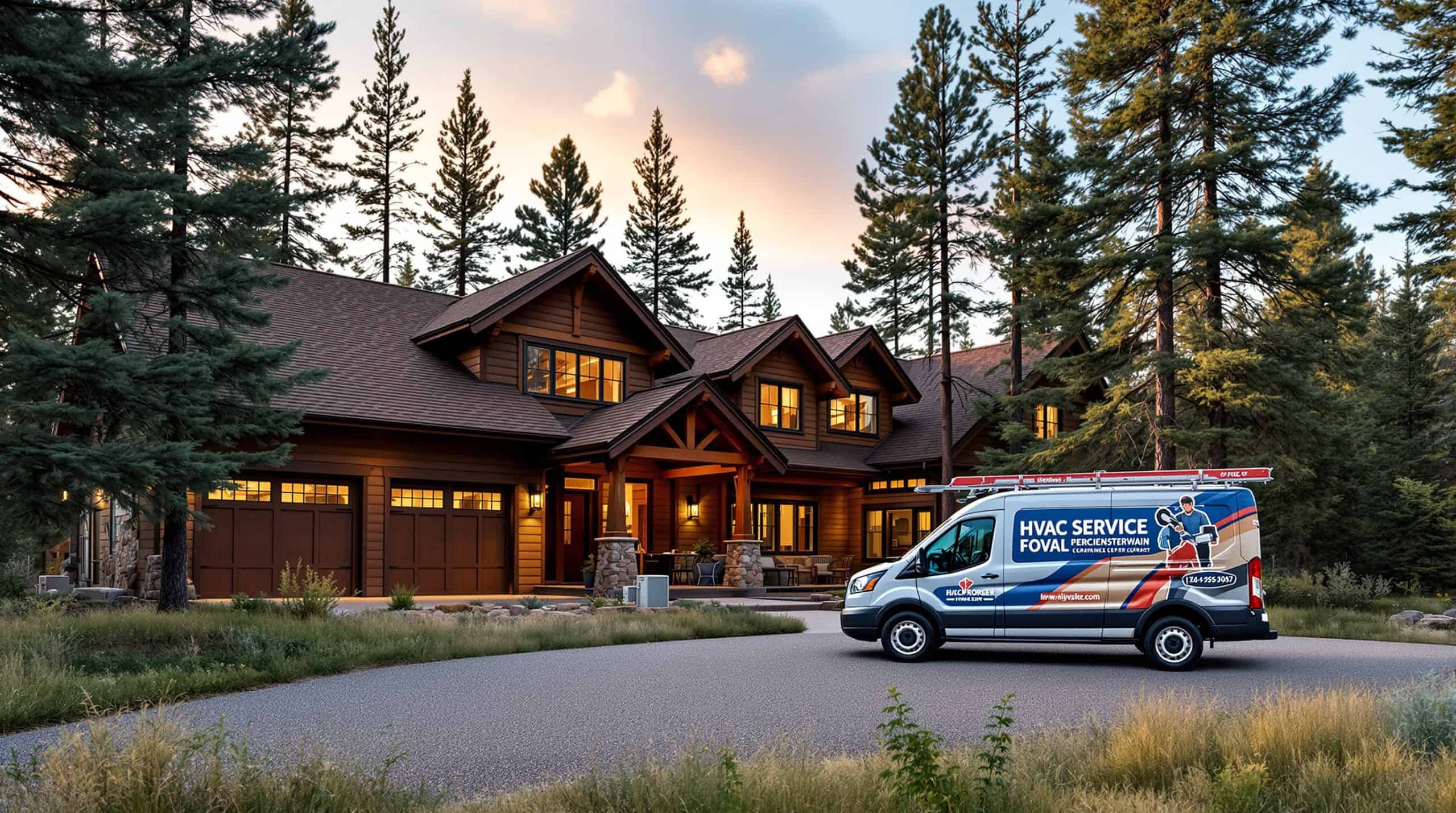
It's a January morning in Woodland Park, the thermometer reads single digits, and your furnace has been running almost nonstop since midnight without ever quite catching up. Meanwhile your sister down in Colorado Springs, thirteen hundred feet lower, is perfectly warm on the same system model. That gap isn't bad luck or a faulty unit. It's elevation, and it changes the math on almost everything your HVAC system does.
Key Takeaways
- Elevation changes combustion, not just comfort: At Woodland Park's roughly 8,465 feet, thinner air carries less oxygen, so furnaces need gas input adjustments to burn safely and efficiently.
- Off-the-shelf sizing calculations fall short: Manual J load calculations built for sea-level or even Colorado Springs elevation can leave a Woodland Park system undersized or oversized without altitude corrections.
- Symptoms show up as comfort problems first: Short cycling, uneven room temperatures, and furnaces that never seem to shut off are often altitude-sizing issues, not equipment failures.
- Not every contractor adjusts for elevation: Ask direct questions before hiring, because altitude-correct installation is a specialty skill, not a standard practice.
- The right adjustments pay off in efficiency and comfort: Properly calibrated systems cycle less, distribute heat more evenly, and last longer under Woodland Park's demanding winters.
1. Why Woodland Park's Elevation Changes How HVAC Systems Perform
Woodland Park sits at roughly 8,465 feet above sea level, nearly 2,500 feet higher than Colorado Springs and well above the elevation most HVAC equipment is factory-calibrated for. At that height, the air is thinner, which means every cubic foot contains less oxygen than the same volume at sea level. That single fact ripples through nearly every part of a heating and cooling system, from how a gas furnace burns fuel to how efficiently a compressor moves refrigerant.
For a furnace, combustion depends on a precise ratio of gas to oxygen. When oxygen is scarce, an uncorrected furnace can either burn too rich, producing excess carbon monoxide and soot, or run inefficiently as it struggles to reach its rated output. For air conditioners and heat pumps, thinner air also means reduced air density moving across coils, which affects how much heat the system can actually transfer per hour. A three-ton unit at sea level does not deliver three tons of cooling capacity at Woodland Park's elevation unless it has been selected and adjusted with that difference in mind.
The Manual J Problem at High Elevation
Manual J load calculations, the industry-standard method for sizing HVAC systems, are built around assumptions that shift with elevation. A calculation that ignores Woodland Park's altitude can produce a system that looks correctly sized on paper but performs like it's undersized in the field. The Department of Energy notes that equipment efficiency and output ratings are tested under standardized conditions that do not reflect mountain-elevation performance, which is exactly why altitude corrections matter for accurate sizing.
Furnace Combustion and Carbon Monoxide Risk
Altitude-correct furnace installation typically involves adjusting the gas orifice size or input rate so the burner receives the right fuel-to-air ratio for the available oxygen. Skipping this step doesn't just hurt efficiency, it raises the risk of incomplete combustion and elevated carbon monoxide production. Every furnace tune-up in a home at Woodland Park's elevation should include a combustion analysis and carbon monoxide check, not as an optional extra but as a baseline safety step.
Why Equipment Selection Matters More Here Than Elsewhere
Not every furnace, air conditioner, or heat pump model is well suited to high-altitude operation, even among reputable manufacturers. Some units include factory-published high-altitude derate charts and kits specifically for this purpose, while others require more careful field adjustment. A comfort advisor who understands Woodland Park's demands will factor this into equipment selection before installation day, not after the first cold snap exposes the problem.
2. Common Symptoms of an Undersized or Improperly Calibrated System
Homeowners rarely think "my furnace wasn't adjusted for altitude" when something feels off. Instead, they notice a room that never quite warms up, a system that runs constantly without ever fully satisfying the thermostat, or utility bills that climb every winter without an obvious cause. These are the practical, lived symptoms of altitude miscalibration, and they show up gradually rather than as a dramatic failure.
Short cycling is one of the clearest signs. A furnace or air conditioner that turns on and off frequently, rather than running a full, steady cycle, is often struggling to match its output to the load it was actually installed to handle. Uneven temperatures between rooms, especially in homes with additions, finished basements, or bonus rooms, frequently trace back to ductwork and equipment sized without altitude and layout both taken into account.
Furnace Running Constantly Without Reaching Set Temperature
When a furnace runs for extended stretches, sometimes hours at a time, without the house reaching its thermostat setting, that is a strong signal of undersizing or reduced output from uncorrected combustion. It is easy to mistake this for "the furnace is getting old," but age and altitude miscalibration can produce nearly identical symptoms. A trained comfort advisor can distinguish between the two with diagnostic testing rather than guesswork.
Uneven Heating and Cold Spots Room to Room
Cold spots in specific rooms, particularly those farthest from the furnace or on the north side of a home, often point to a combination of duct design and equipment output that wasn't calculated for Woodland Park's elevation and terrain. In older homes especially, ductwork installed decades ago may never have accounted for altitude-adjusted airflow requirements in the first place.
Rising Utility Bills Without a Clear Cause
When heating costs climb year over year with no change in usage habits, an inefficient or improperly sized system is a common culprit. A furnace working harder than it should to compensate for combustion inefficiency burns more fuel to produce the same result, and that inefficiency shows up directly on the gas bill.
3. How Proper Altitude Adjustments Improve Comfort and Efficiency
Getting the sizing and combustion adjustments right changes the day-to-day feel of a home in ways that go well beyond a comfortable thermostat reading. A properly calibrated system cycles less often, but each cycle does more work, so rooms heat and cool evenly instead of in fits and starts. That steadier operation also reduces mechanical wear, since components that aren't constantly starting and stopping tend to last longer.
Efficiency gains compound over a heating season. A furnace burning at the correct fuel-to-air ratio converts more of the gas it consumes into usable heat rather than wasted combustion byproducts, which shows up as lower monthly bills. On the cooling side, an air conditioner or heat pump sized and charged correctly for elevation moves the right volume of refrigerant to match the thinner air passing across its coils, avoiding both the short-cycling problems of oversizing and the constant-running problems of undersizing.
The comparison below illustrates what altitude-correct installation changes versus a standard, uncorrected approach.
| Factor | Uncorrected Installation | Altitude-Adjusted Installation |
|---|---|---|
| Furnace combustion | Fuel-to-air ratio set for sea-level oxygen | Gas input and orifice adjusted for Woodland Park elevation |
| Equipment sizing | Manual J calculation without elevation factor | Load calculation corrected for actual site elevation |
| Cycling behavior | Frequent short cycles or constant running | Full, steady cycles matched to actual load |
| Carbon monoxide risk | Elevated risk from incomplete combustion | Verified safe combustion through analyzer testing |
| Energy bills | Higher, inconsistent usage | Lower, more predictable usage |
| Equipment lifespan | Accelerated wear from cycling stress | Extended service life under normal operating stress |
The pattern is consistent across nearly every home A & Z services above 8,000 feet: correcting for altitude is not a cosmetic upgrade, it is the difference between a system that merely runs and one that actually performs as designed. Homeowners who have lived with an uncorrected system for years often describe the difference after a proper adjustment as immediate and obvious, particularly during the first genuinely cold week of winter.
4. What to Ask a Contractor Before Hiring for Woodland Park Installs
Not every HVAC contractor working in El Paso and Teller County treats altitude as a distinct variable in their sizing and installation process. Some apply the same Manual J inputs and combustion settings they'd use for a home in Colorado Springs or Fountain, without adjusting for Woodland Park's meaningfully higher elevation. Homeowners can protect themselves from this gap simply by asking the right questions before signing a contract.
Start by asking whether the contractor performs an elevation-adjusted Manual J load calculation as a standard part of every installation, not just for unusual jobs. Follow up by asking whether furnace combustion is tested with a calibrated analyzer after installation, confirming the actual fuel-to-air ratio rather than assuming factory settings are close enough. These two questions alone will usually reveal whether altitude is a routine part of a contractor's process or an afterthought.
Ask About Combustion Analyzer Testing
A combustion analyzer measures the actual byproducts of combustion, oxygen levels, carbon monoxide, and flue gas temperature, to confirm a furnace is burning correctly at your specific elevation. Any contractor installing or servicing a furnace above 8,000 feet should be using this tool as a matter of course, not as a special request. If a contractor can't describe how they verify combustion at altitude, that's worth noting.
Ask How They Handle Manual J Calculations for Elevation
Ask specifically whether their load calculation software or method accounts for elevation as an input, and ask them to explain in plain terms how that changes the recommended equipment size for your home. A contractor who has done this work in Woodland Park before should be able to answer without hesitation.
Ask About Experience with Your Specific Home Type
Older Woodland Park homes, cabins converted to year-round residences, and properties without existing ductwork each present different challenges. Ask whether the contractor has installed systems in homes similar to yours, and whether they offer options like small-duct high-velocity systems for houses that were never built with traditional ductwork in mind.
5. Heating and Cooling Options Suited to Woodland Park's Homes and Climate
Woodland Park's housing stock ranges from newer construction to older mountain cabins, log homes, and properties converted from seasonal use to full-time residences, and not every home is a natural fit for a standard forced-air furnace and central AC setup. Homes without existing ductwork, common among older cabins and additions, present a real challenge for homeowners who assume central heating and cooling means tearing open walls and ceilings.
This is where A & Z's Unico small-duct high-velocity certification becomes genuinely relevant to Woodland Park homeowners, not just a marketing footnote. Unico systems use small, flexible supply tubing that can snake through existing wall cavities, joist spaces, and tight attic areas without the demolition a conventional duct retrofit requires. For historic and older mountain homes where preserving plaster walls, log construction, or original architectural details matters, this is often the only realistic path to whole-home comfort.
Cold Climate Heat Pumps at Altitude
Modern cold climate heat pumps have improved significantly and can handle genuinely cold temperatures, but their performance at Woodland Park's elevation and winter lows deserves an honest conversation rather than a blanket recommendation. Manufacturer documentation from Armstrong Air outlines performance curves at various outdoor temperatures, and a knowledgeable comfort advisor should walk through those specifics for your home rather than assuming a heat pump alone will handle the coldest Woodland Park nights without backup heat. Xcel Energy offers rebates up to $2,250 for qualifying heat pump installations, which is worth factoring into the total cost picture when weighing options.
Aeroseal for Homes with Existing Ductwork
For Woodland Park homes that already have ductwork but suffer from uneven heating and high bills, leaky ducts are frequently the hidden culprit rather than the furnace itself. Aeroseal duct sealing addresses this from the inside, sealing leaks throughout the duct system without opening walls or ceilings. A new, correctly sized furnace paired with leaky ducts still loses conditioned air before it ever reaches the room, so duct sealing and equipment sizing should be evaluated together, not separately.
Traditional Furnace and AC Systems, Done Right
For homes with straightforward layouts and existing ductwork in good condition, a traditional Armstrong Air furnace and air conditioner combination remains a solid, proven choice, provided every step from load calculation through combustion testing accounts for Woodland Park's elevation. The equipment itself isn't the differentiator here. The installation process is.
6. Maintenance and Seasonal Readiness at Altitude
Regular maintenance matters everywhere, but it carries extra weight at Woodland Park's elevation because the margin for error is smaller. A furnace that's slightly out of tune at sea level might waste a bit of fuel; the same furnace slightly out of tune at 8,465 feet can drift into unsafe combustion territory faster, simply because there's less oxygen available to buffer the mistake. Annual furnace tune-ups should always include a carbon monoxide check and combustion analysis, not as an upsell but as a baseline safety practice for high-altitude homes.
Seasonal readiness also looks a little different in Woodland Park than it does down in Colorado Springs proper. Winter arrives earlier and lingers longer at higher elevation, and temperature swings between day and night can be more extreme. Homeowners who schedule furnace tune-ups in early fall, before the first hard freeze, give their comfort advisor time to catch combustion or airflow issues while there's still room to schedule a repair without an emergency call in the middle of a snowstorm.
Air conditioning maintenance matters too, even in a mountain town known more for cold winters than hot summers. Woodland Park does see warm afternoons through the summer months, and a neglected AC system that hasn't been checked in years is more likely to fail on the one week it's actually needed. A spring check-up, paired with the fall furnace tune-up, keeps both systems ready for whatever the season brings without surprises.
FAQs
What size furnace do I need for a home in Woodland Park's elevation?
The right size depends on an elevation-adjusted Manual J load calculation specific to your home's square footage, insulation, windows, and layout, not a generic rule of thumb. A furnace sized correctly for a similar home at Colorado Springs elevation is often the wrong size for Woodland Park. A comfort advisor should perform this calculation before recommending equipment.
How often should I get furnace maintenance living at high altitude?
Annual furnace tune-ups are recommended for every home, but at Woodland Park's elevation, that annual visit should always include a combustion analysis and carbon monoxide check. Scheduling this in early fall, before the first hard freeze, gives time to address any issues before peak heating season.
Can a heat pump actually keep up with Woodland Park winters?
Modern cold climate heat pumps can handle genuinely cold conditions, but performance at Woodland Park's elevation and winter lows should be evaluated for your specific home rather than assumed. Many homeowners pair a heat pump with backup heat for the coldest stretches, and Xcel Energy rebates up to $2,250 can offset qualifying installations.
Does my older Woodland Park home need ductwork torn out for central air?
Not necessarily. Unico small-duct high-velocity systems use flexible tubing that fits through existing wall and joist cavities, which is a realistic option for older cabins, log homes, and historic properties without existing ductwork or the willingness to open walls.
How fast can A & Z respond for emergency HVAC service in Woodland Park?
A & Z Mechanical offers 24/7 emergency service across its Colorado Springs area coverage, including Woodland Park. Call as soon as a system fails, especially during winter cold snaps, since heating outages at this elevation can become urgent quickly.
Conclusion
Woodland Park's elevation isn't a footnote to HVAC service, it's the central fact that should shape every sizing decision, combustion setting, and equipment recommendation made for a home there. From furnace combustion analysis to Manual J calculations corrected for actual site elevation, the details that get overlooked at sea-level installation standards are exactly the details that determine whether a Woodland Park homeowner spends winter comfortable or fighting a system that never quite catches up.
A & Z Mechanical has served Colorado Springs and the surrounding communities, including Woodland Park, Monument, and Black Forest, since 2001, and that history includes real, hands-on experience with the altitude-specific challenges this region presents. As an Armstrong Air Authorized Dealer holding Colorado Mechanical A License No. MA050286, and the only Unico small-duct certified installer in the Colorado Springs market, our comfort advisors bring both the technical grounding and the honest diagnostics Woodland Park homeowners deserve, backed by a team that stands by every job and small-town ethics that don't change based on your zip code's elevation.
Get A Quote to get an elevation-adjusted assessment of your Woodland Park home's heating and cooling needs, whether you're sizing a new furnace, exploring Unico for a home without ductwork, or troubleshooting a system that never seems to keep up.