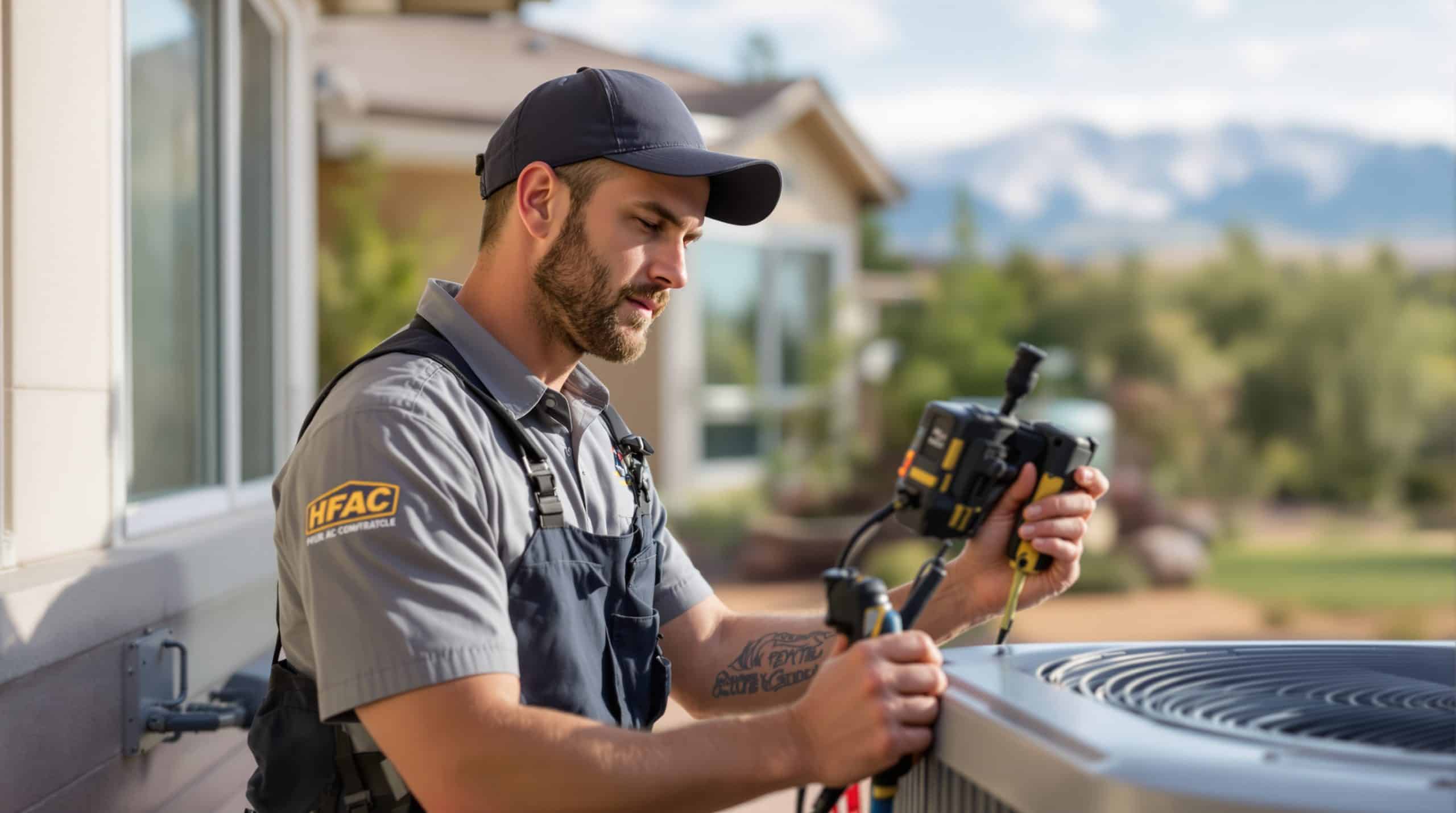
It's a 95-degree afternoon in July, your air conditioner just quit, and a technician you found through a same-day ad is standing in your living room telling you the compressor is shot and the whole system needs to go today. Your kids are sweating, the dog is panting by the vents, and you have about ten minutes to decide whether to trust a stranger with a five-figure number. That moment, more than any other, is when Colorado Springs homeowners get taken advantage of.
Key Takeaways
- Urgency is the biggest tell: Legitimate diagnostics take time and explanation, so pressure to decide in minutes is a warning sign, not a sales tactic you should ignore.
- Vague answers hide vague work: A technician who cannot explain what failed and why should not be authorized to fix it.
- Refrigerant, capacitors, and compressors are the most common overcharge targets: Knowing what these parts actually do helps you tell a fair quote from an inflated one.
- Licensed, upfront pricing is verifiable, not just a slogan: Ask for it in writing before any work begins.
- A second opinion costs you almost nothing compared to an unnecessary system replacement: It is always worth the wait, even in extreme heat.
1. Why AC Repair Scams Spike During Colorado Springs Summers
Colorado Springs summers are short but intense, and when temperatures climb into the 90s, air conditioning failures spike all at once. That surge in demand creates exactly the conditions that dishonest actors look for: homeowners who are uncomfortable, worried about their kids or elderly parents overheating, and desperate for same-day service. When everyone in a neighborhood needs help at once, some homeowners end up calling whoever answers the phone fastest rather than researching who is actually qualified, and that is where the risk starts.
The problem is made worse by the fact that a lot of AC failures in this climate are genuinely simple to fix. A tripped breaker, a clogged condensate line, or a failed capacitor can all mimic a "major system failure" to someone who does not do this for a living. A technician who is simply trying to hit a sales quota before the summer rush ends has every incentive to describe a small problem as a big one. The heat itself becomes a pressure tool, whether the technician intends it that way or not.
The seasonal timing pattern
Scams and aggressive upselling tend to cluster in the first heat wave of the season and again during any extended stretch above 90 degrees. That is when call volume outpaces the number of honest, available comfort advisors in the area, and it is also when homeowners are least likely to shop around. If your AC fails during one of these stretches, treat the situation as urgent for your comfort, but not so urgent that you skip basic verification steps.
Why older Colorado Springs homes are targeted more often
Homes in the Old North End, Manitou Springs, and other older neighborhoods often have aging ductwork, undersized equipment for today's cooling loads, or systems that were never quite right for the altitude to begin with. That combination of age and complexity gives a dishonest technician more room to invent problems, because the homeowner already suspects something is outdated or fragile. It also means legitimate issues are more likely, which makes a careful, documented diagnosis even more important.
How the summer rush affects response time and judgment
When call volume is high, some companies fill schedules with less experienced technicians or subcontractors who are paid per job rather than by the hour. That pay structure rewards speed and upselling over accuracy. It is worth asking directly whether the technician coming to your home is a direct employee and how they are compensated, because how a company pays its people shapes the advice you get.
2. Red Flags: Fake Urgency, Vague Diagnostics, and Pressure Tactics
The clearest scams rarely announce themselves as scams. They show up as a technician who seems friendly, competent, and in a hurry, all at once. Learning to recognize the pattern matters more than memorizing a list of bad companies, because the tactics repeat themselves regardless of who is using them.
Fake urgency is the most common tactic, and it works because it short-circuits your ability to think clearly. Phrases like "this could fail completely tonight" or "I can only hold this price if you approve right now" are designed to move you from questioning to signing before you have time to call anyone else. A technician telling you a part is on the truck and available for installation today, but only if you decide immediately, is using scarcity to close a sale, not to help you.
Vague or unverifiable diagnostics
Ask a legitimate technician what failed and why, and they should be able to show you. A bad capacitor can be tested with a multimeter and the reading shown to you. A refrigerant leak should be located, not just assumed. If a technician tells you the compressor is "going bad" without pointing to a specific measurement, error code, or visible symptom, that is a vague diagnosis, and vague diagnoses are the foundation of most overcharges. Ask them to explain it the way they would explain it to another technician, then ask them to translate that into plain English for you.
Pressure tactics disguised as helpfulness
Some of the most effective pressure does not sound like pressure at all. A technician who says "I'd hate for your family to be without AC for another night" or "most homeowners in your situation just replace the whole system" is framing a decision as already made. Watch for language that assumes your consent, discourages you from getting a second opinion, or frames any hesitation as risky for your home or health. A technician confident in their diagnosis should welcome a second look, not discourage one.
3. Common Overcharges: Refrigerant Recharges, Capacitors, and Compressor Claims
Three components account for a disproportionate share of AC repair disputes in Colorado Springs: refrigerant, capacitors, and compressors. Each one is a legitimate repair when it is actually needed, and each one is also a favorite target for inflated invoices, because homeowners rarely know what these parts cost to source or how long they take to replace. Understanding the difference between a fair repair and an inflated one on these three items alone will protect you from the majority of AC scams.
Refrigerant is probably the most misunderstood. Modern systems use a fixed charge, and a properly sealed system should never need "topping off" on a regular basis. If a technician tells you your system just needs more refrigerant without first identifying and showing you a leak, that is a red flag. Refrigerant type also matters: as the industry transitions toward lower global-warming-potential refrigerants like R-454B under EPA guidance, technicians handling older R-410A systems need appropriate certification and equipment, and pricing should reflect the actual refrigerant used, not a vague "recharge fee."
| Component | What a legitimate repair looks like | Common overcharge red flag |
|---|---|---|
| Refrigerant | Leak located and shown, refrigerant type confirmed, correct amount charged to manufacturer spec | "Topping off" with no leak search, or repeated recharges every season |
| Capacitor | Tested with a multimeter, reading shown, replaced with correct microfarad rating | Replaced without testing, or priced far above the part's low material cost |
| Compressor | Diagnosed with amperage and pressure readings, failure explained in specific terms | Called "bad" based on age or noise alone, used to justify a full system replacement |
Why capacitor replacement gets inflated
A capacitor is one of the least expensive parts in the whole system, and it is also one of the most common actual failures, especially in a climate with big daily temperature swings that stress electrical components. Because it is cheap to source and quick to install, it is a favorite upsell target: a technician can replace it in minutes and charge as though it were a much larger job. A fair technician will show you the failed capacitor, explain the reading that led them to replace it, and price the labor honestly for the time it actually took.
Why compressor claims deserve extra scrutiny
The compressor is the most expensive component in an outdoor unit, and calling it "bad" is often the fastest way to justify recommending full system replacement instead of a repair. A legitimate compressor diagnosis involves specific amperage and pressure readings, not just age or a loud noise. If a technician recommends compressor replacement, ask whether repair is even possible given the age and refrigerant type of the system, and get the readings that led to that conclusion in writing.
4. Questions to Ask Before You Approve Any Repair
The fastest way to protect yourself is to ask a short set of direct questions before you sign anything, and to pay attention to how comfortable the technician is answering them. A technician who is doing honest work should welcome these questions, because they are the same questions any competent comfort advisor would expect from a careful homeowner.
Start with the diagnosis itself. Ask what specifically failed, what measurement or test confirmed it, and whether they can show you the reading or the part. Then ask what the repair involves step by step, roughly how long it should take, and whether the price reflects parts, labor, or both separately. A technician who can answer all of this clearly, without hesitation or vague generalities, is much more likely to be giving you an honest assessment.
Questions about pricing and scope
Ask for the price in writing before work begins, not after the job is finished. Ask whether the quote is flat-rate or time-and-materials, and whether there is a diagnostic fee that gets applied toward the repair if you move forward. Ask directly how they're trained to diagnose problems, since that single question often reveals more about incentive structure than anything else you could ask.
Questions about your options
Ask what happens if you decide not to do the repair today. A technician pushing hard against this question, rather than explaining the actual risk of waiting, is worth being cautious about. Ask whether a repair is possible at all, or whether they are only offering replacement, and ask them to explain that reasoning in terms of the specific parts and age of your system rather than in general statements about "systems this old."
Questions about the company itself
Ask whether the technician is a direct employee, what license number the company operates under, and how long they have served the Colorado Springs area specifically. A company with two decades of local history and a clear licensing structure has much less incentive to burn trust with a bad repair than a subcontractor working a single summer season in town.
5. How Licensing and Transparent Pricing Protect Homeowners
Licensing exists for a reason that goes beyond paperwork: it creates accountability. A licensed contractor operating under Colorado's contractor requirements has a business reputation and a license on the line every time a technician walks into a home, which changes the incentive structure in a homeowner's favor. That accountability does not guarantee honesty on its own, but it removes the anonymity that makes fly-by-night operators comfortable overcharging in the first place.
Manufacturer certification adds another layer of protection. A & Z Mechanical is an Armstrong Air Authorized Dealer and holds Colorado Mechanical A License No. MA050286, meaning the team has been tested and licensed to the same technical standards used across the industry rather than trained only on one company's shortcuts. Being the only Unico small-duct high-velocity certified installer in the Colorado Springs market and one of the only Aeroseal duct sealing certified contractors in the region also means the company has invested in training that most competitors have not, which tends to correlate with a more careful, standards-based approach to every job, not just the specialty work.
What transparent pricing actually looks like
Transparent pricing means you see the number before the work starts, you understand what it covers, and it does not change once the technician is already inside your condenser unit. It also means the company trains and holds its comfort advisors accountable. A & Z's comfort advisors are trained to diagnose the actual problem, which removes the incentive to recommend a repair or replacement you do not need. That structure is a specific, verifiable claim, not just a promise, and it is worth asking any contractor you are considering whether they can say the same thing about their own technicians.
Why Accountability After the Invoice Matters
A company that stands by its diagnostics consistently gives homeowners a real way to judge whether a contractor is being straight with them. A & Z has held a BBB A+ rating for over 20 years and has served El Paso County as a Family Operated business since 2001, which is the kind of track record that gets built through honest diagnostics repeated over thousands of jobs, not through a single good review. When you are evaluating any contractor, ask how long they have operated under the same name in the same market, because a long, stable local history is one of the hardest things for a scam operation to fake.
6. What Getting a Second Opinion Looks Like in Colorado Springs
A second opinion is not an insult to the first technician, and it is not a delay you cannot afford, even in extreme heat. In most cases, a second visit takes only a few hours to arrange, and the cost of that visit is small compared to what you could lose by approving an unnecessary compressor replacement or a full system swap that was never actually needed. Treat a second opinion the same way you would treat a second opinion from a doctor before a major procedure: reasonable, expected, and protective of your interests.
The most useful second opinion comes from a company that can look at the same system with fresh eyes and either confirm the original diagnosis or point out where it does not hold up. Bring whatever documentation the first technician gave you, including any readings, photos, or written quotes, and share them directly. A comfort advisor evaluating a second opinion should be able to look at those numbers and tell you plainly whether they support the conclusion that was drawn from them.
When a second opinion is worth the wait, even in summer heat
If the recommended repair or replacement costs more than a routine service call, if the diagnosis was vague, or if you felt pressured to decide immediately, those are all signals that a second opinion is worth the short delay. Most Colorado Springs homes can survive an afternoon or even a full day without air conditioning using fans, shade, and reduced activity during peak heat, especially if you have vulnerable family members staying with a neighbor or relative temporarily. That short-term discomfort is almost always a better trade than an unnecessary repair.
How A & Z approaches a second opinion request
A & Z Mechanical treats a second opinion call the same way it treats any other diagnostic visit: with an honest assessment based on what the equipment is actually doing, not on what was said in a previous visit. Comfort advisors are trained to explain findings in plain language, show their work, and give you options rather than a single ultimatum. That approach reflects the company's "We Air Because We Care" commitment, which is meant to describe how decisions get made in your home, not just a slogan on a truck.
FAQs
How can I tell if an AC repair company is trying to scam me in Colorado Springs?
Watch for pressure to decide immediately, vague explanations of what failed, and a reluctance to show you readings or the actual failed part. Ask for the diagnosis in writing and get a second opinion if the quote is large or the explanation feels rushed.
Is it normal for an air conditioner to need refrigerant added every year?
No. A properly sealed AC system should hold its refrigerant charge for years, and repeated "topping off" almost always points to an undiagnosed leak. If a technician recommends adding refrigerant without locating and showing you a leak, ask them to find the leak first.
How much does it typically cost to get a second opinion on an AC repair?
Second opinion visits are usually priced as a standard diagnostic call, separate from the original company's quote. Contact a licensed local contractor directly for a quote rather than assuming the cost, since it depends on the scope of the evaluation needed.
Is an HVAC maintenance plan worth it for preventing repair scams?
Yes, in an indirect but real way. Regular maintenance with a trusted, known contractor means you already have a documented service history and a relationship with a comfort advisor, which makes it much harder for an unfamiliar technician to convince you of a fabricated emergency repair.
How fast does emergency AC service typically respond in Colorado Springs during summer?
Response times vary by company and by how busy the season is, but many established local contractors offer 24/7 emergency service and prioritize no-cooling calls during extreme heat. Ask directly about expected arrival time when you call, and treat vague answers about timing as another data point when evaluating the company.
Conclusion
The pattern behind most AC repair scams in Colorado Springs is consistent: manufactured urgency, vague explanations, and pressure aimed at the three most commonly inflated components, refrigerant, capacitors, and compressors. Homeowners who ask direct questions, request documentation, and are willing to pause for a second opinion put themselves in a much stronger position, even during the hottest stretch of summer. Licensing, manufacturer certification, and transparent, hourly-paid pricing structures are not just marketing language when a company can actually verify them, and they are worth asking about before you let anyone into your mechanical room.
A & Z Mechanical has served El Paso County homeowners since 2001 with the same small-town ethics the company was built on, backed by Armstrong Air Authorized Dealer status, Colorado Mechanical A License No. MA050286, and a BBB A+ rating held for over 20 years. Whether you need a straight answer about a compressor claim you received from another company or a full diagnostic on a system that just quit in the July heat, honest diagnostics and a handshake you can trust are the standard, not the exception.
Get A Quote to have a licensed A & Z Mechanical technician evaluate your air conditioner, confirm any diagnosis in writing, and give you an upfront price before any repair work begins. If you already have a quote from another company that feels rushed or unclear, bring it along and we will tell you plainly whether it holds up.